These essays aren’t perfect, but we can learn much of value from them
Review of the Recorded Books audio edition, narrated by Jefferson Mays. Written for LibraryThing, 29 July 2012, and posted to Amazon on 30 July 2012 under the headline above. Four stars.
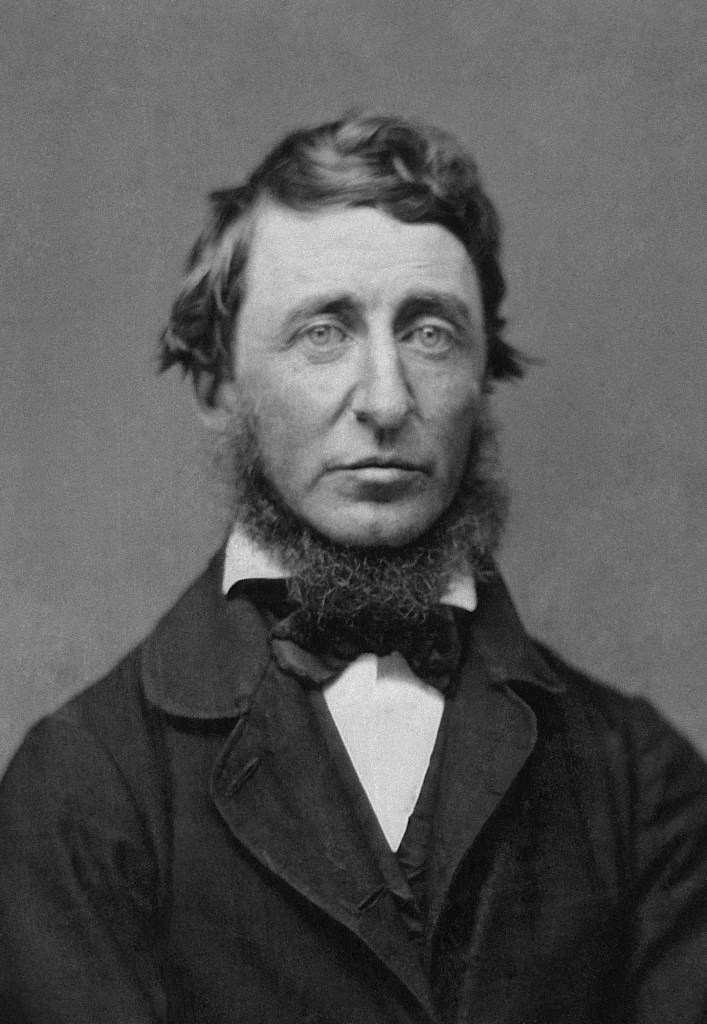
“There will never be a really free and enlightened State until the State comes to recognize the individual as a higher and independent power, from which all its own power and authority are derived, and treats him accordingly.”
So concluded Henry David Thoreau in his seminal essay, “Civil Disobedience”. Originally titled “Resistance to Civil Government”, it was later published as “On the Duty of Civil Disobedience” because it was written in part as an answer to William Paley’s “Of the Duty of Civil Obedience”. This is somewhat confusing, however, since Thoreau makes it quite clear that he does NOT believe civil disobedience to be a duty, but rather thought it proper for people to be primarily concerned with the business of living: “I came into this world, not chiefly to make this a good place to live in, but to live in it, be it good or bad.” He said only that one should resist when failure to do so brings harm to others: “It is not a man’s duty, as a matter of course, to devote himself to the eradication of any, even the most enormous wrong; he may still properly have other concerns to engage him; but it is his duty, at least, to wash his hands of it, and, if he gives it no thought longer, not to give it practically his support. If I devote myself to other pursuits and contemplations, I must first see, at least, that I do not pursue them sitting upon another man’s shoulders. I must get off him first, that he may pursue his contemplations too.” (And even then he refrained from judging those who failed to resist out of, for example, fear of the consequences to their families.) (See Wendy McElroy’s essay on “Civil Disobedience”, particularly the penultimate section, “A duty to resist?”).
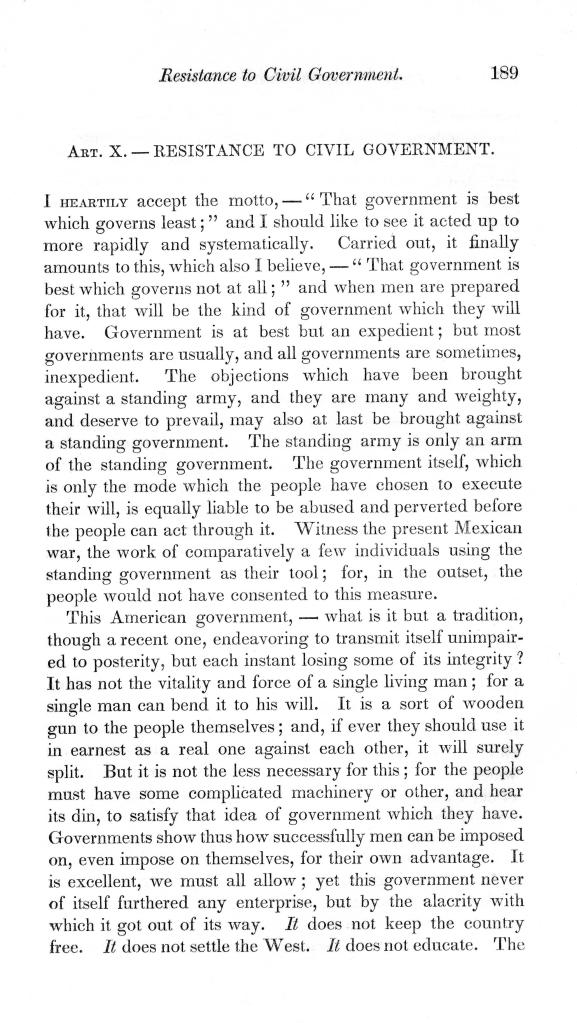
Really, the best way to review “Civil Disobedience” is to let Thoreau speak for himself. A few more key passages, starting with this early one expressing a clearly true, but rarely practiced, idea: “I think that we should be men first, and subjects afterward. It is not desirable to cultivate a respect for the law, so much as for the right.”
“The mass of men serve the state thus, not as men mainly, but as machines, with their bodies…. In most cases there is no free exercise whatever of the judgment or of the moral sense…. Yet such as these even are commonly esteemed good citizens…. A very few, as heroes, patriots, martyrs, reformers in the great sense, and men, serve the state with their consciences also, and so necessarily resist it for the most part; and they are commonly treated as enemies by it.”
“All men recognize the right of revolution; that is, the right to refuse allegiance to, and to resist, the government, when its tyranny or its inefficiency are great and unendurable. But almost all say that such is not the case now. But such was the case, they think, in the Revolution of ’75. If one were to tell me that this was a bad government because it taxed certain foreign commodities brought to its ports, it is most probable that I should not make an ado about it, for I can do without them. All machines have their friction; and possibly this does enough good to counterbalance the evil. At any rate, it is a great evil to make a stir about it. But when the friction comes to have its machine, and oppression and robbery are organized, I say, let us not have such a machine any longer.”
Unfortunately, Thoreau is not always entirely consistent. He opens with the motto, “‘That government is best which governs least'”, and continues, “Carried out, it finally amounts to this, which also I believe, — ‘That government is best which governs not at all’; and when men are prepared for it, that will be the kind of government which they will have.” The second proposition, however, does not necessarily follow from the first (depending on how one interprets it). And when Thoreau goes on to differentiate himself from the “no-government men” of his day, it becomes hard to tell what exactly he is advocating. Is he an anarchist, or not? A sort of gradualist anarchist, or what? (And indeed, scholars have debated precisely this point for many decades.) Thoreau basically tells us what he is against, but he is much more vague about what he is for. He asserts that “Government is at best but an expedient,” but never gives any argument for or content to this claim. This does not seem to be consistent with his conclusion with which I opened this review, and leaves us with little guidance as to what might be the proper functions of government, if any. So on the whole, “Civil Disobedience” is a very good essay, one might well say a great essay, but in some respects somewhat lacking or inconsistent.
Also included in this collection are “Life Without Principle”, “Slavery in Massachusetts”, “A Plea for Captain John Brown”, and “Walking”. These essays are generally even more philosophically mixed than “Civil Disobedience” (in that he makes some poor arguments for unsound conclusions), but there is a lot of good material in them as well.
“Life Without Principle” is perhaps the most interesting of these, though ultimately a bit disappointing. It sounds like a piece on what might be called “practical philosophy”, like he will explain the importance of principles AS SUCH in daily living; instead, it’s more on the “practical” side than the “philosophical” side, as he just offers a number of principles by way of advice on how to live well. It is by and large good advice, though he clearly has little or no understanding of economics, which leads him into one or two blunders. He really doesn’t have that much to say about the subject of the title that is deeply insightful.
“Slavery in Massachusetts” and “A Plea for Captain John Brown” are both passionate denunciations of slavery, and I certainly sympathize with Thoreau’s sympathy for Brown, but there is more moral fervor here than practical solutions.
“Walking” is about a certain way of life that includes an appreciation for nature, very reminiscent of parts of Walden. Thematically, it doesn’t have much to do with “Civil Disobedience”, but if you liked Walden, you’ll probably enjoy this.
On the whole, these essays aren’t perfect, but we can learn much of value from them…recommended reading.

