We all want to be more effective writers. Like public speaking (but often even more so), improving your writing is a force multiplier that enables you to perform more effectively in many other areas as well, because writing is a basic principle of many fields, from the obvious to the seemingly mundane to the more subtle, to, well, public speaking. These days, there aren’t many fields that don’t involve writing as a critical component which can’t be used to significantly improve your overall effectiveness.
But what are the basic principles of writing itself? In order to answer this question, or to gain a deep understanding of any subject and most effectively implement our intentions and achieve any related goal, it is often useful to start from first principles. James Clear, author of Atomic Habits, has called reasoning from first principles “one of the most effective strategies you can employ for breaking down complicated problems and generating original solutions.” So what are they, and how can you leverage them to achieve such results?
First Principles
The idea of first principles was defined by the 4th-century B.C.E. philosopher Aristotle in his treatises establishing the science of formal logic and applied by him to many other domains, from physics and biology to (of particular relevance to us) communication and persuasion (in the Rhetoric) and even the dramatic arts (in the Poetics). They are “the first basis from which a thing is known” (Metaphysics, 1013a14–15), the basic facts of a particular domain that explain how everything else in that domain works, and which “are not themselves explained by reference to more basic facts” within that domain (Gotthelf 2012, p. 155). These fundamental explanatory truths cannot usefully be further analyzed or reduced, but are the root causes of the phenomena in question. The classic example is the axioms of Euclid’s geometry; another would be Darwinian natural selection in the field of evolutionary biology.
Writing as an Information Technology
So what is writing, at root? Basically, it’s an information technology predating electronic computers or even the printing press (though both have vastly amplified its reach and power). All such information technologies can be analyzed into their component parts, typified by the basic architecture of the computer as defined by John von Neumann in 1945. Von Neumann’s template (slightly simplified) included:
- an input mechanism;
- a processor that performs transformations on data ultimately derived from the input mechanism (such as arithmetic or other logical operations);
- a storage unit or “memory” that can record data from the input mechanism or the processor (which can then be retrieved and processed further at a later time); and
- an output mechanism to display processed information.
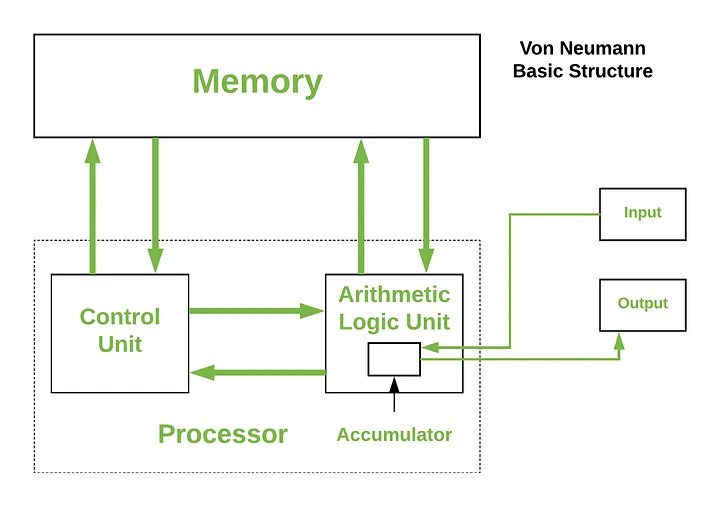
Interestingly, at this high level of abstraction, von Neumann’s architecture resembles biological mechanisms which are themselves basically information processing systems, not least of which is human consciousness, after the contemporary abstract understanding of which von Neumann largely modeled his approach to creating artificial information processing devices. And since writing is itself an output of the human mind, it may be helpful to reduce it back still further to the fundamental principles of consciousness… which brings us back, of course, to Aristotle.
Writing and Consciousness
Consciousness is fundamentally relational, and the basic relationship it detects among things is difference. Specifically, it relates them “according to the more and the less”, to use Aristotle’s apt phrase. In the Categories, for example, he writes that “Qualities [e.g., whiteness] admit of variation in degree” (Cat. 8 10b26), and in the Parts of Animals he discusses how in each kind “the parts differ… as largeness and smallness, softness and hardness, the smooth and the rough… by the more and the less” (PA 1.4, 644b11, trans. Pierre Pellegrin in Gotthelf and Lennox 1987, pp. 332–33). Thus, the basic level of awareness could be described as differential.
The next level up detects relationships of similarity, which is a higher-order difference relationship: “These things are less different from each other than they are from that other thing, and I can thus classify them together under the same category for purposes when that smaller difference is less salient than the larger one.” So two cats may differ from one another in their various attributes, but when compared to a dog those differences are relatively small and can thus be ignored when relating cats in general to dogs in general. Now we can integrate cats as such into a single category on the basis of their salient similarities. This level of awareness could be described as integral.
There are still higher levels of pattern recognition that we could go on to describe, but for our present purposes the important point is that the two basic functions of consciousness are differentiation and integration, or analysis and synthesis, or zooming in and out, or any other similar terminology that’s basically just a different way of describing the same general phenomena. To return to our von Neumann model of information processing systems,
- our perceptual system (as filtered through our attention and directed by our intentions) is the input mechanism;
- our mind and brain (conscious and subconscious) is the processor, and differentiation and integration are the basic operations it performs;
- our subconscious memory banks that are somehow embodied in the brain are the storage unit; and
- the outputs are the physically expressed results of this processing, including via language in the form of speech and other modes of communication… such as writing.
First Principles of Effective Writing
So what are the implications of these basic principles of writing as a form of information processing and an expression of human consciousness? First of all, to differentiate it (see what I did there?) from other, more ephemeral, forms of communication, writing is a way to outsource our memory storage, as biological memory is notoriously unreliable. This not only enables us to retrieve information even when we might otherwise have difficulty recalling it from our own subconscious mind, it also can aid in information processing by increasing the amount of data we can work with at a given time; thought experiments and visualization aside, Einstein might have had trouble developing his theories of relativity without the aid of pen and paper or a chalkboard, or some such writing tools. So as a writer it helps to be aware of these potential advantages in order to fully utilize them.
But even more deeply, knowing that what it is to know, is to relate things according to the more and the less, to differentiate and integrate, can help us communicate more clearly whatever form it may take, including the written word. To form a distinct idea is to define it in relation to your existing knowledge, and to communicate it to another mind is to define it in relation to theirs… and the best, and easiest, way to do that is with the tools of differentiation and integration, to contrast and compare, to analogize, to analyze and to generalize, as appropriate of course.
This can also help you avoid some of the most common mistakes in writing (beyond basic grammar and so forth), which often amount to too much differentiation or integration, at the expense of the other. Too much integration can become a castle in the sky, so be sure to ground your abstract theories with plenty of concrete examples. On the other hand, too much differentiation without tying it all together somehow can become just a meaningless (and tedious) laundry list, so make sure it all adds up to something.
These principles and tools can be fruitfully applied at every level and every stage of the writing process, from diction and sentence structure to the overarching organization of a book; from brainstorming to outlining to drafting to revising. An analysis of how to do this at each step is obviously beyond the scope of this article, but in future pieces I hope to explore some of them further. This is the first of a series applying these principles at each stage of writing.
References
- Aristotle, Metaphysics Δ.1, 1013a14–15; Categories 8, 10b26; Parts of Animals I.4, 644b11 (trans. Pierre Pellegrin).
- Clear, James. “First Principles: Elon Musk on the Power of Thinking for Yourself.” jamesclear.com.
- Gotthelf, Allan. Teleology, First Principles, and Scientific Method in Aristotle’s Biology. Oxford University Press, 2012.
- Gotthelf, Allan, and James G. Lennox, eds. Philosophical Issues in Aristotle’s Biology. Cambridge University Press, 1987.
- von Neumann, John. First Draft of a Report on the EDVAC, 1945.

