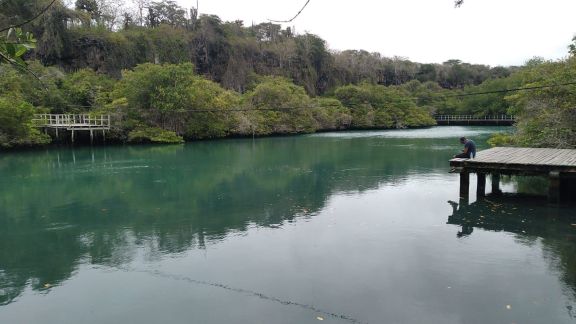
Written at the Laguna de las Ninfas in Puerto Ayora on the morning of 30 March 2022, as that day’s gratitude post.
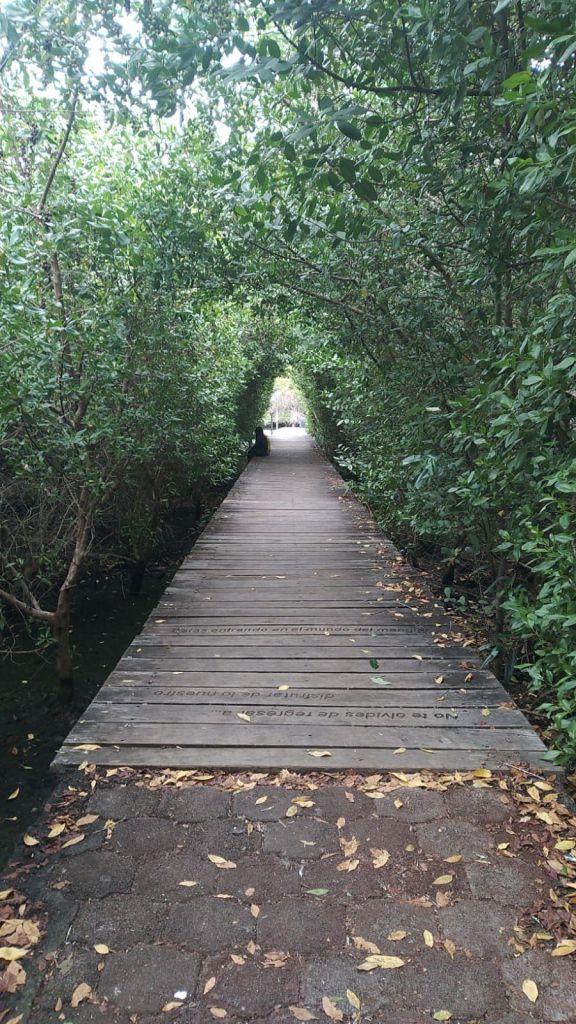
The other day I talked about risk-taking versus stability. Sitting at the Laguna and observing the wildlife, it’s easy to see that this issue is not unique to human beings, but a trait that goes far back in our evolutionary heritage. At the most basic level, if you’re part of a school of fish or a herd of grazing animals, and you’re weaker and slower than the others, you’re more likely to get left behind and eaten by a predator… classic survival of the fittest. But there are higher-order levels of fitness and adaptation operating too. If you’re the fish that always plays it safe and sticks in the middle of the school, you’re less likely to get as much food as the fish that ventures out a little farther… and thus less likely to be as strong and fit. So there’s always an interplay between the advantages to being the more risk-taking fish and the more cautious one that gives rise to a constantly evolving balance.
Much the same is true of any species with some level of social organization, including Homo sapiens, the species with by far the most complex social organization of all. True, we’re basically at the top of the food chain, not prey animals like fish or grazing herd animals (after all, we hunt all of them). But the same issue arises in contexts of predation… The lone wolf is less likely to be a successful hunter than a well functioning pack (which is why hunting in packs evolved in the first place, because it provides evolutionary advantages over simply being the single biggest, strongest predator like, say, a T. rex 🦖), but it’s typically the alpha members of the pack, the strongest or even just the most aggressive (again, up to a point, there’s always a balance), that end up passing on their genes, not the more timid, cautious ones. 🐺
And human beings aren’t just simple predators, but can cultivate the values we need to survive and thrive, and specialize in their cultivation to become even better at it and exchange them for those produced by others with different specializations, thereby creating more value than exists ready-made in nature to simply graze or hunt (even if we did start out as a species of hunter-gatherers). But again, this tension and balance between being more of a lone, individual risk-taker versus a cautious, community-oriented person is built into our basic means of survival at the very deepest levels… Specialization AND exchange requires both individual effort and contribution (and the greater the specialization, i.e. the differentiation between one and the rest of society, the greater the potential rewards, precisely because it’s also a greater potential risk to do something different than everyone else) on the one hand, AND connection to the group on the other (after all, there’d be no point to greater differentiation and specialization if it wasn’t followed up with the exchange of the values produced thereby and greater integration into the larger social structure). This is why Jacob Bronowski in The Ascent of Man referred to humanity as “the social solitary”. We are simultaneously the most highly individualistic, and the most highly social and communitarian, species to have ever evolved on this planet… which might sound like a contradiction or a paradox, but actually one naturally gives rise to the other in an ever-evolving spiral—just like the one in the school of fish in the Laguna between the cautious fish and the daring one (only on a much higher level and greater scale).
I am grateful to be a member of such a species, that can enjoy the fruits of being both highly unique individuals, and part of the most complex and intricate social structure ever to evolve (and which is now, thanks to the modern transportation and communications networks made possible by modern science and technology that I posted about yesterday, interconnected on a global scale, which further increases those potential benefits by orders of magnitude thanks to exponential network effects).

