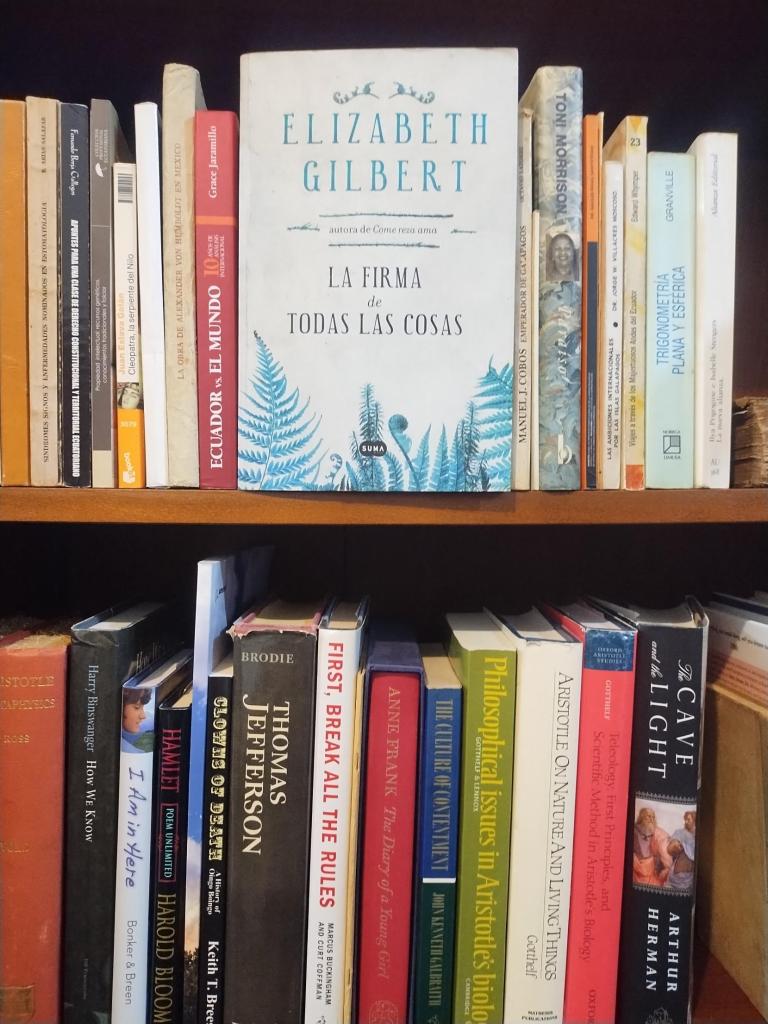
Posted to Amazon on 28 May 2018 under the headline below. Five stars.
A gripping novel about a 19th century Dutch woman who…studies moss?
Yes! Unlike most of the other reviewers, I haven’t read Eat, Pray, Love yet (though I did enjoy Big Magic), but I was totally unprepared for how rich and engrossing this story would be. Beautifully written with deeply engaging characters, The Signature of All Things is perhaps the greatest artistic portrayal of the process of discovery and the people who drive it, and are driven by it, that I have ever encountered. Brilliantly layered and integrated, it perfectly dramatizes the idea of adaptation through, well, a story about the discovery of the idea of adaptation.
And yes, it centers around a woman who studies…wait for it…moss. I think this was a deliberate choice on the author’s part to find the dullest sounding subject she could, in part to parallel her protagonist’s contemporary Darwin’s years-long, in-depth analysis of, um, barnacles, but also to demonstrate that beauty can be found in the most seemingly unlikely, unremarkable places and the greatest insights sometimes spring from them… As Aristotle wrote in his famous Invitation to Biology, urging students of nature not to shy away from the study of “lowly” or mundane organisms, “There are gods here, too.1” (Grass is also fascinating, btw, the old cliche “about as exciting as watching grass grow” notwithstanding.)
Other reviewers have mentioned feeling like it kind of bogs down in the middle, and I will admit that there are a couple of stretches where I started wondering where Gilbert was going with this, but stick with it with an open mind and I promise it will all pay off in the end. I don’t want to give away any spoilers, but the final chapter had me weeping. Copiously.
An instant classic, and now one of my personal favorite novels of all time. I really can’t recommend it highly enough.
1. Aristotle, On the Parts of Animals I.5, 645a4–36, quoted in Lennox, James and Mariska Leunissen, “Aristotle’s Biology“, The Stanford Encyclopedia of Philosophy (Summer 2026 Edition), Edward N. Zalta & Uri Nodelman (eds.). ↩

